

CLIMATE CHANGE AND LOW-CARBON DEVELOPMENT
The Company views climate change as a key factor potentially impacting the long-term sustainability of its business, strategic priorities, investment attractiveness, and the socio - economic development of its regions of operation. Strengthening climate regulation, the development of carbon pricing mechanisms, changing hydrocarbon demand structures, and rising investor expectations regarding climate disclosure transparency pose both risks (regulatory, market, technological, physical, and transitional) and opportunities (improving energy efficiency, developing low-carbon products, and new business lines) for the Company.
Climate factors are integrated into strategic and investment planning, budgeting, asset management, and the corporate risk management system, ensuring that potential financial impacts are taken into account when making management decisions.
The climate agenda is an integral part of corporate governance, and the management of climate risks and opportunities is integrated into decision-making at the Board/Committee and Management Board levels.
The Company’s approach to climate change management is based on:
- compliance with national and international obligations of the Republic of Kazakhstan in the field of climate change, including the goal of achieving carbon neutrality by 2060;
- a gradual and economically justified reduction in the carbon intensity of activities, considering industry specifics, technological maturity and the availability of solutions.
Key elements of the approach:
- strategic integration of the climate agenda into corporate and investment management processes;
- systematic identification and assessment of climate risks and opportunities within the corporate risk management system;
- development of adaptation mechanisms to physical and transient climate risks, including increasing the resilience of production and energy infrastructure;
- improving the transparency, monitoring, and quality of climate disclosures in line with international best practices (IFRS S2, GRI, CDP, ISO 14064)
Climate strategy and goals
The Company’s climate strategy is set out in the 2060 Climate Change Strategy, which is valid for the 2025 reporting year. The Climate Change Strategy aims to reduce greenhouse gas emissions, improve energy efficiency and conservation, develop low- carbon technologies, including renewable energy sources, methane emissions management (OGMP), and implement innovative projects in CCUS, hydrogen energy, sustainable aviation fuel (SAF), and offset projects. The strategy is integrated into capital planning, asset management, and the CRMS.
Greenhouse gas emission reduction targets
In accordance with the LCDP-2060 the Company sets quantitative and qualitative targets for reducing greenhouse gas emissions and developing low-carbon solutions. These targets are based on national climate targets, international commitments, and energy transition scenarios.
The base year for assessing emissions dynamics was 2019, as it represents the period before the COVID-19 pandemic and reflects the typical level of the Company’s operating activities.
KMG uses internal carbon pricing when evaluating investment projects and conducting scenario analysis. Internal price assumptions are updated annually and used in stress testing investment decisions.
KMG’s operations are subject to the national emissions trading system (Kazakhstan ETS), and the EU ETS applies to certain assets (including those in the downstream perimeter). The company is implementing a compliance strategy: monitoring regulatory changes, energy efficiency programs, developing renewable energy sources, strengthening the Monitoring, Reporting, and Verification (MRV) system, preparing for expanded methane/carbon regulations, and the use of an automated monitoring system (AMS).
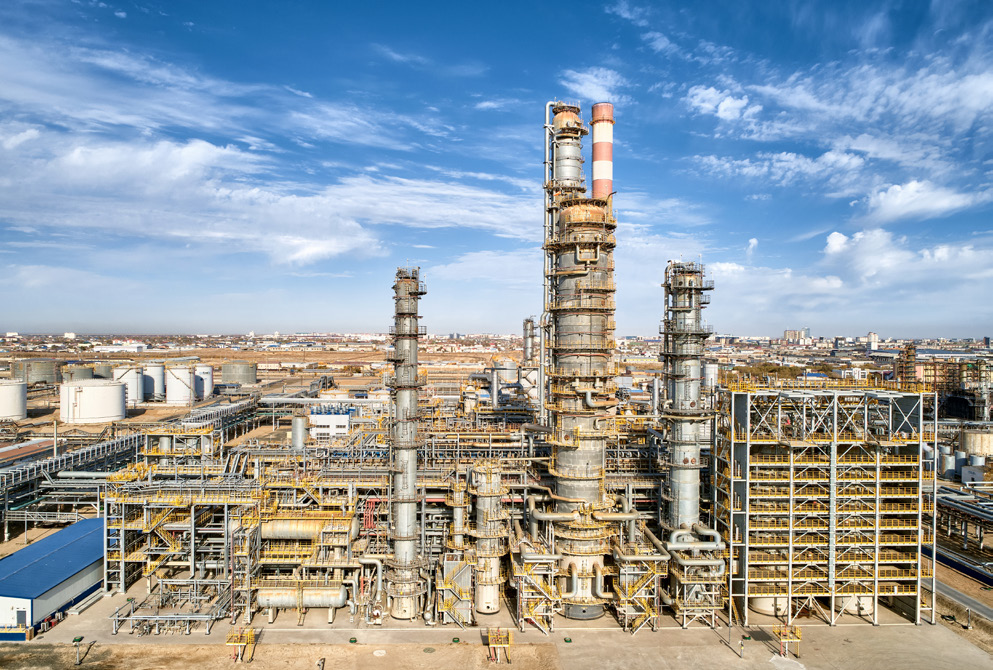
Targets for 2031
- 15% reduction in direct (Scope 1) and indirect (Scope 2) emissions compared to the 2019 level;
- 32% reduction in methane emissions;
- 15% reduction in carbon intensity;
- at least a 15% share of renewable energy sources in the electricity consumption mix;
- complete elimination of routine gas flaring;
- implementation of a forest climate offset project covering 1,600 hectares.
Targets for 2060
- 64% reduction in direct (Scope 1) and indirect (Scope 2) emissions, taking into account decarbonization measures and the use of offset mechanisms;
- 96% reduction in methane emissions;
- 60% reduction in carbon intensity;
- achievement of a 50% share of renewable energy sources in the electricity consumption mix;
- implementation of forest climate offset projects on an area of up to 11,600 hectares;
- injection of up to 421 thousand tonnes of CO₂ as part of CCUS projects;
- production of up to 1.4 million tonnes of sustainable aviation fuel (SAF) (portfolio target, subject to market and regulatory readiness);
- achievement of an “A” rating in the CDP climate rating.
The achievement of these targets establishes a long term pathway for reducing the Company’s carbon footprint and supports a phased transition to a low-carbon development model. These targets and scenarios (realistic / “green” / deep decarbonization) are set out in the Low-carbon Development Program–2060, including forest climate projects, OGMP/LDAR, and CCUS/hydrogen/SAF initiatives.
To assess the materiality of impacts and support decision making, KMG applies both quantitative and qualitative approaches, including EBITDA based assessment, as well as Value at Risk (VaR) hand Cash flow at Risk (CFaR) methodologies.
Integration of climate and ESG indicators into the management incentive system
To ensure the implementation of sustainable development principles and the LCDP–2060, climate and environmental aspects have been integrated into the Company’s key performance indicator (KPI) system for management.
The remuneration of members of the Management Board and heads of functional areas partially depends on the achievement of indicators related to climate and environmental risk management, implementation of decarbonization projects, and enhancement of disclosure transparency.
In the reporting year, the incentive system included, among others, the following indicators:
At the level of the Chairman of the Management Board (corporate KPIs):
- implementation of investment projects, including sustainable development initiatives and the construction of a 247 MW hybrid power plant;
- an integrated indicator for industrial safety performance.
At the level of Deputy Chairmen of the Management Board and functional executives:
- implementation of investment and environmental projects;
- approval and implementation of environmental protection programs;
- implementation of measures to improve energy efficiency and optimize electricity consumption in subsidiaries;
- achievement of target levels in international CDP and ESG ratings.
Thus, climate and environmental factors are directly taken into account in evaluating management performance and determining the variable component of remuneration, contributing to the integration of sustainable development principles into the Company’s operational and investment activities.