

Contribution of the Company to the Achievement of the UN Sustainable Development Goals
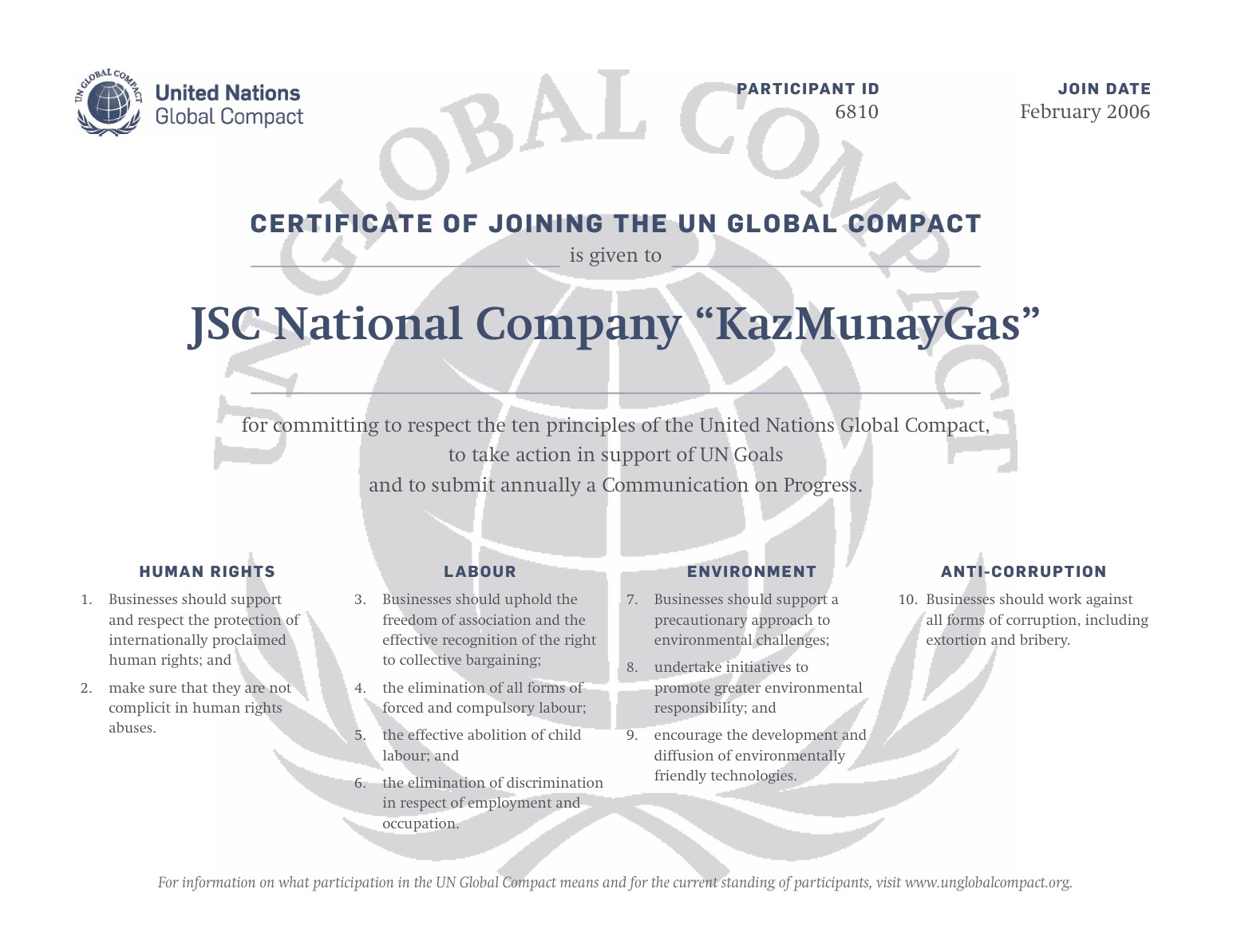
UN Global Compact
Since 2006, KMG has been a participant of the United Nations Global Compact and actively contributes to its implementation. The Company's annual Sustainable Development Report reflects its progress in fulfilling the principles of the UN Global Compact.
In its operations, the Company strives to achieve sustainable development by integrating the UN principles, global trends, national development priorities of the Republic of Kazakhstan, and universal values into its business strategy.
| Area | Principle |
|---|---|
| Human Rights | 1. Businesses should support and respect the protection of internationally proclaimed human rights. |
| 2. Businesses should make sure that they are not complicit in human rights abuses. | |
| Labour relations | 3. Businesses should uphold the freedom of association and the effective recognition of the right to collective bargaining. |
| 4. Businesses should uphold the elimination of all forms of forced and compulsory labour. | |
| 5. Businesses should uphold the effective abolition of child labour. | |
| 6. Businesses should uphold the elimination of discrimination in respect of employment and occupation. | |
| Environment | 7. Businesses should support a precautionary approach to environmental challenges. |
| 8. Businesses should undertake initiatives to promote greater environmental responsibility. | |
| 9. Businesses should encourage the development and diffusion of environmentally friendly technologies. | |
| Anti‑Corruption | 10. Businesses should work against corruption in all its forms, including extortion and bribery. |
These principles form the foundation of KMG’s strategic initiatives aimed at sustainable development and the creation of long‑term value for stakeholders.
The Company recognizes all 17 UN Sustainable Development Goals and consistently integrates them into its operations. Taking into account its strategic priorities and key development objectives, KMG focuses on contributing to the achievement of 10 priority SDGs and 23 related targets, within which the Company’s core initiatives and projects are implemented.
Integration of the Sustainable Development Goals into KMG’s Operations
Good Health and Well-being
SDG Targets:
- 3.6. Reduce the number of deaths and injuries resulting from road traffic accidents.
- 3.8. Achieve universal health coverage, including access to quality essential health‑care services and access to safe, effective, quality and affordable essential medicines and vaccines.
- 3.9. Substantially reduce the number of deaths and illnesses resulting from exposure to hazardous chemicals and air, water and soil pollution and contamination.
KMG’s Key Initiatives:
- “Trip Management” Project – implementation of a transport management system with a focus on traffic safety.
- Employee Wellness Program (2024–2028) – health monitoring for employees with chronic conditions, preventive measures, innovative pre-shift health screenings, improved accessibility and quality of medical care.
- Medical Insurance – regular medical checkups and employee vaccinations.
- Measures to reduce occupational health risks and prevent adverse exposure to harmful factors.
KMG’s Results for 2025:
- The Trip Management Project has been put into industrial operation in KMG’s oilfield service subsidiaries.
- In three oilfield service subsidiaries (Oil Services Company LLP, Oil Construction Company LLP, Oil Transport Corporation LLP), the Trip Management Project has completed the transition to a digital format.
- A unified system functionality has been implemented, including planning, analytics, and road safety modules.
- 1,592 employees of subsidiaries and 3,410 contractor employees completed Defensive Driving training.
- 20,073 employees of KMG subsidiaries and 2,321 contractor employees participated in practical safety belt demonstration exercises.
- The Action Plan for KMG’s Employee Health Improvement Program for 2025–2027, comprising 26 activities, was approved; the average implementation rate in 2025 amounted to 77.9%.
- 21,546 employees received training in providing first pre‑medical aid (paramedic skills) at the workplace.
- 1,633 medical emergency drills of all levels were conducted, testing the Emergency Medical Response Plan.
- The phased implementation of the Automated Medical Examination System (hereinafter – AMES) has continued since 2021 – 69 hardware units were installed in 2025.
- 100% of KMG employees are covered by the medical insurance program.
- Annual occupational sanitary and epidemiological inspections were conducted across all subsidiaries.
- The safety of drinking water, workplace air quality, and working conditions have been confirmed.
Gender Equality
SDG Targets:
- 5.1. Eliminate all forms of discrimination against all women and girls everywhere.
- 5.5. Ensure women’s full and effective participation and equal opportunities for leadership at all levels of decision‑making in political, economic and public life.
KMG’s Key Initiatives:
- Implementation of the Women’s Empowerment Principles (WEPs), including a gender gap self-assessment and public disclosure of gender composition data.
- Strict adherence to the labor legislation of Kazakhstan to prevent any form of discrimination.
- JanAru educational program.
- Increase the share of women in top management positions across KMG Group to 30 % by 2030.
KMG’s Results for 2025:
- A WEPs self‑assessment was conducted, identifying strengths and areas for improvement in advancing gender equality.
- KMG’s HR policy is implemented based on the principles of gender equality, diversity, and non‑discrimination.
- A non‑discriminatory and transparent approach to recruitment and selection has been ensured.
- The JanAru educational program was implemented for women in working professions in the oil and gas industry.
- Women’s representation on the KMG Board of Directors and Supervisory Boards reached 13.1% in 2025.
Affordable and
Clean Energy
SDG Targets:
- 7.1. Ensure universal access to affordable, reliable and modern energy services.
- 7.b. Expand infrastructure and upgrade technology supplying modern and sustainable energy services.
KMG’s Key Initiatives:
- Improving energy efficiency through equipment upgrades and the implementation of automated metering systems.
- Development of Renewable Energy Resources (RES) projects: wind power projects (1 GW) in partnership with TotalEnergies Renewables SAS and Qazaq Green Power PLC, and a hybrid power plant (247 MW) in partnership with Eni.
- Procurement of “green” electricity (15% of total consumption by 2031).
- Production of Sustainable Aviation Fuel (SAF) based on ethanol.
KMG’s Results for 2025:
- During the reporting period, 87 energy efficiency and energy-saving measures were completed, resulting in a reduction of greenhouse gas emissions by 128.3 thousand tonnes of CO₂.
- A 50 MW solar power plant was commissioned in the Mangystau Region; construction of a 120 MW gas-fired power plant under the hybrid project is ongoing.
- The detailed design phase of the 1 GW “Mirny” WPP project with an energy storage system is nearing completion.
- 10,000 green certificates (I‑REC) were purchased.
- Under the SAF production project, a framework agreement was signed with LanzaJet to advance the project to the FEED stage.
Decent Work and Economic Growth
SDG Targets:
- 8.5. Achieve full and productive employment and decent work for all women and men, including young people and persons with disabilities, and equal pay for work of equal value.
- 8.6. Substantially reduce the proportion of youth not in employment, education or training.
- 8.8. Protect labour rights and promote safe and secure working environments for all workers.
KMG’s Key Initiatives:
- Youth engagement programs, graduate training and employment, preparation of specialized professionals, and internship opportunities.
- Social support for employees through collective agreements (more than 50 types of benefits).
- Leadership Code and employee commitment to complying with industrial safety requirements.
- “Qorgau” Safety Card – identification and prevention of unsafe working conditions.
KMG’s Results for 2025:
- Employment of approximately 49 thousand workers ensured, of whom 82% are men and 18% are women; the Company applies a non‑discriminatory approach to remuneration and personnel selection.
- Programs for the development of young specialists and staff training are being implemented, including “Zhas Maman”, dual training, “Alyp”, and “Zheti qadam”.
- Collective agreements are in force across the KMG Group, providing for more than 70 types of social support.
- The volume of financing for social benefits in 2025 totaled KZT 114 billion.
- Implementation of “Qorgau” Safety Card is underway – a total of 12,530 cards were completed in 2025.
- The 9th annual HSE Forum was held, aimed at strengthening leadership and safety culture.
- Occupational working conditions assessments and corporate occupational safety audits were carried out across all subsidiaries; based on the results, 613 recommendations were issued to 15 subsidiaries.
Industry, Innovation
and Infrastructure
SDG Targets:
- 9.1. Develop quality, reliable, sustainable and resilient infrastructure, including regional and transborder infrastructure, to support economic development and human well‑being, with a focus on affordable and equitable access for all.
- 9.4. Upgrade infrastructure and retrofit industries to make them sustainable, with increased resource‑use efficiency and greater adoption of clean and environmentally sound technologies and industrial processes.
KMG’s Key Initiatives:
- Development and implementation of the Advanced Base and Artificial Intelligence (hereinafter — ABAI) information system for centralizing all production data across the KMG Group and processing it using artificial intelligence and machine learning.
- Within KMG’s Low-Carbon Development Program until 2060, priority measures are being implemented, including the development of energy management, the introduction of automated systems for accounting and managing energy resources, the application of best available techniques, and the modernization of equipment and the vehicle fleet.
KMG’s Results for 2025:
- Continued development and scaling of digital solutions: replication of the “Waterflood Management” module, development of the “Digital Well Rating” and “Production Planning and Monitoring” modules, as well as optimization of the ABAI system architecture.
- Pilot projects in industrial safety and digital monitoring are being implemented, including the automated intelligent occupational safety system “TUMAR” and predictive analytics solutions for equipment failure at refineries.
- In 2025, 87 measures were implemented, ensuring a reduction of 128.3 thousand tonnes of CO₂ and annual energy savings of 1,935.5 thousand GJ.
- Measures to modernize equipment and infrastructure are being carried out, including burner replacement, installation of variable‑frequency drives, implementation of solar thermal solutions, and improvement of the energy efficiency of technological processes.
Sustainable Cities and Communities
SDG Targets:
- 11.6. Reduce the adverse per capita environmental impact of cities, including by paying special attention to air quality and the management of municipal and other waste.
KMG’s Key Initiatives:
- Participation in the “Taza Kazakhstan” initiative aimed at improving the environmental situation.
- Creation of a “green belt” through landscaping projects.
- Implementation of Best Available Techniques (BAT) to reduce environmental impacts step-by-step.
- Development of a pollutant emission reduction program.
- Implementation of the World Bank’s “Zero Routine Flaring by 2030” Initiative.
- Development of “green offices” and separate waste collection systems.
KMG’s Results for 2025:
- Environmental and volunteer initiatives were implemented, including participation in the “Taza Kazakhstan” campaign (282 community clean‑up events involving more than 9,000 participants).
- Landscaping and reforestation programs continue: since 2021, approximately 650 thousand trees have been planted. The total number of trees planted across the KMG Group in 2025 amounted to 263.7 thousand, including 150 thousand pine seedlings planted in the Kostanay Region with KMG’s financial support.
- Automated emission monitoring systems with online data transfer were implemented in 5 subsidiaries; an integrated environmental permit was obtained, and measures to introduce BAT are being carried out.
- A program to reduce pollutant emissions has been developed and is expected to be approved by the end of 2026.
- Since 2017, the volume of routine flaring of raw gas has been reduced by 86.4%; continuous monitoring and measures for further reductions are underway.
- Green office initiatives are being implemented, including separate waste collection and the installation of a reverse vending machine – since 2023, more than 76 thousand containers have been collected.
Responsible Consumption and Production
SDG Targets:
- 12.4. Achieve the environmentally sound management of chemicals and all waste throughout their life cycle, in accordance with agreed international principles, and significantly reduce their release into air, water and soil in order to minimize their negative impacts on human health and the environment.
- 12.5. By 2030, substantially reduce waste generation through prevention, reduction, recycling and reuse.
- 12.6. Encourage companies, especially large and transnational companies, to adopt sustainable practices and to disclose information on the efficient use of resources in their reporting.
KMG’s Key Initiatives:
- Historical oil waste disposal program.
- “Tazalyk” project at Atyrau Oil Refinery LLP for wastewater treatment.
- Implementation of a waste management standard.
- Water resource management program.
KMG’s Results for 2025:
- A total of 4,668 thousand tonnes of historically accumulated oil waste has been disposed of across the KMG Group since 2019.
- In 2025, approximately 338.8 thousand tonnes of historically accumulated oil waste were disposed of at Ozenmunaygas JSC and Mangistaumunaigas JSC.
- At Atyrau Oil Refinery LLP, the second stage of the project “Reconstruction of Mechanical Treatment Facilities (closed‑type MTF)” was completed.
- In 2025, the waste management standard was implemented in KMG’s subsidiaries and affiliates.
- A draft Water Resource Management Program has been developed, including action plans for subsidiaries and affiliates. Approval of the Program is expected by the end of 2026.
Climate Action
SDG Targets:
- 13.2. Integrate climate change response measures into policies, strategies and planning.
- 13.3. Improve education, awareness-raising and human and institutional capacity on climate change mitigation, adaptation, impact reduction and early warning.
KMG’s Key Initiatives:
- Implementation of internal carbon pricing.
- Participation in the Carbon Disclosure Project and disclosure of climate‑related risks in accordance with IFRS S2.
- Methane emissions management in cooperation with international partners.
- Forest-climate offset project in partnership with Chevron in Pavlodar Region.
- Participant in the UNEP OGMP 2.0 methane initiative.
- Participant in the Charter on the Decarbonization of the Oil and Gas Sector.
- Participant in the Caspian Methane Emissions Reduction Accelerator.
KMG’s Results for 2025:
- The action plan for the implementation of KMG’s Low‑Carbon Development Program until 2060 was approved.
- Projects in the field of hydrogen energy are being implemented: as part of the pilot project for the development of green hydrogen, a solar power supply system was commissioned for the laboratory building of KMG Engineering LLP; delivery of an electrolyzer is expected; the feasibility study for blue hydrogen has been completed.
- A framework agreement was signed with LanzaJet to move the SAF production project to the FEED stage.
- A positive conclusion of the state environmental review was obtained for the forest‑climate project.
- Training activities and practical methane leak measurements were conducted; reporting was completed in accordance with the OGMP 2.0 standard, and a draft corporate standard on methane emissions management was developed.
- With the support of OGCI, aerial monitoring of methane leaks is being conducted, and proposals have been submitted to improve national regulation in the oil and gas sector.
Life on Land
SDG Targets:
- 15.3. Combat desertification, restore degraded land and soil, including land affected by desertification, droughts and floods, and strive to achieve land degradation neutrality.
- 15.5. Take significant action to reduce the degradation of natural habitats, halt the loss of biodiversity and ensure the conservation of threatened species and prevent their extinction.
KMG’s Key Initiatives:
- Construction of a desalination plant in Kenderli with a capacity of 50 thousand m³ of water per day.
- Land rehabilitation activities.
- Execution of the “Tazalyk” environmental project aimed at improving environmental conditions.
- Development of a biodiversity conservation program and cooperation with environmental organizations.
- Implementation of the principles of the mitigation hierarchy (avoidance, minimization, restoration, compensation).
KMG’s Results for 2025:
- In 2025, the desalination plant in Kenderli was commissioned and subsequently transferred to the local executive body.
- Activities aimed at restoring contaminated land and reducing pollutant discharges are being implemented.
- As part of reforestation efforts, 150 thousand pine seedlings were planted in the Kostanay Region.
- Reconstruction of the wastewater disposal system and reclamation of evaporation fields continues at Atyrau Oil Refinery LLP, including drainage and reclamation of sectors and the conversion of an open canal into a pipeline.
- At Atyrau Oil Refinery LLP, the project for the reconstruction of mechanical treatment facilities (closed‑type MTF) has been completed.
- A draft Biodiversity Conservation Program has been developed; the principles of the mitigation hierarchy are embedded in KMG’s Environmental Policy.
Partnerships for the Goals
SDG Targets:
- 17.1. Strengthen domestic resource mobilization, including through international support to developing countries, to improve domestic capacity for tax and other revenue collection.
- 17.16. Enhance the Global Partnership for Sustainable Development, complemented by multi-stakeholder partnerships that mobilize and share knowledge, expertise, technology and financial resources, to support the achievement of the Sustainable Development Goals in all countries, in particular developing countries.
- 17.17. Encourage and promote effective public, public-private and civil society partnerships, building on the experience and resourcing strategies of partnerships.
KMG’s Key Initiatives:
- Disclosure of tax reporting, including in accordance with the GRI standard and the OECD Country‑by‑Country Reporting Action 13 initiative.
- Strengthening transparency in corporate governance.
- Participation in international initiatives on sustainable development, environmental protection and emissions reduction.
KMG’s Results for 2025:
- KMG annually discloses information on taxes, payments to the state, and its operations, adhering to leading transparency standards.
- The Company actively cooperates with international agencies and intergovernmental organizations in the implementation of sustainable development projects.
- The Company is a member of international initiatives such as IOGP (International Association of Oil and Gas Producers), CDP (Carbon Disclosure Project), World Bank Zero Routine Flaring and OGMP (Oil and Gas Methane Partnership).