

Implementation of the Corporate Strategy and Key Results
GRI 2-22
In 2025, the development of the oil and gas industry developed against the backdrop of ongoing structural changes in the global energy sector, market transformation, and increasing requirements for business sustainability. Long-term climate targets, technological shifts, and changes in investment priorities are shaping a new configuration of conditions for industry companies and require well-considered strategic decisions.
In this context, KMG is implementing a corporate strategy aimed at strengthening the energy security of the Republic of Kazakhstan, ensuring the sustainable development of the business, and maintaining long-term financial stability. The Company continues to consistently develop its operations as a national vertically integrated oil and gas company that adheres to high standards of industrial safety, environmental responsibility, and corporate governance.
The implementation of KMG's Development Strategy for 2022-2031 is based on expanding the value-creation chain, improving operational efficiency, and diversifying the business. The Company maintains its focus on stable cash flow generation from its core business while simultaneously developing new growth areas, including oil and gas chemicals and low-carbon development projects. During the reporting period, KMG continued to implement the Low-Carbon Development Program until 2060 (hereinafter - LCDP-2060, LCDP), which sets the targets for reducing greenhouse gas emissions and defines the key areas for decarbonization (for more details, see the Climate Change and Low-Carbon Development section).
Planning horizons under LCDP-2060 are as follows: short-term - 0-1 year, medium-term - 1-10 years, and long-term - over 10 years (up to 2060). These horizons are aligned with the asset lifecycle and the goals of LCDP-2060.
KMG's View of the External Environment. For strategic and investment planning, KMG applies a scenario-based framework that includes: (i) the IPCC physical scenarios (RCP 2.6/4.5/8.5) to assess the impacts of temperature change, droughts, and extreme events; and (ii) the transition scenarios of the Network for Greening the Financial System (NGFS) (NDC, "Below 2 °C", "Delayed Transition", "Net Zero Emissions by 2050") to evaluate regulatory tightening, carbon pricing, the energy mix, and technologies. On this basis, a stress test of the sustainability of the strategy and plans is conducted.
Modern global trends confirm that the sustainable development of oil and gas companies is achievable when energy security, business diversification, and consistent adaptation to the climate agenda are addressed simultaneously. In this regard, KMG structures its activities with a view to maintaining a balance between investment in development and adherence to capital discipline.
A key competitive advantage of the Company remains its resilient production cycle across hydrocarbon extraction, transportation, and processing, which ensures reliability of supply and stability of financial performance. The exercise of the priority right to acquire subsoil-use assets contributes to the replenishment of the resource base and the formation of long-term growth potential.
Access to feedstock resources positions the oil and gas chemicals sector as one of the Company's key growth drivers, enabling it to deepen processing and expand its product portfolio. KMG views the development of this sector as an important element in increasing added value and diversifying the business amid the transformation of global energy markets.
As part of its commitment to sustainable development principles, the Company is building a portfolio of low-carbon projects aimed at reducing the carbon intensity of production and improving resource-use efficiency. The adoption of modern technologies, the development of energy saving solutions, and the systematic reduction of the carbon footprint are becoming integral components of the corporate strategy.
Thus, KMG is consistently implementing a strategy aimed at shaping a financially resilient, technologically advanced, and flexible business model capable of effectively responding to global challenges and delivering long-term value for the state, investors, and society.
Vision
A national vertically integrated oil and gas company that meets high safety standards and the principles of sustainable development, focused on maximizing financial performance.
Mission
We develop natural resources efficiently and rationally to ensure energy security, development, and prosperity for Kazakhstan, while caring for future generations.
Strategic Focus Areas
Sufficient resource base to ensure the Company's long-term growth
Improving the Company's value chain efficiency
Business diversification and product portfolio expansion
Sustainable development and progressive reduction of the carbon intensity of production
- Increased reserves for onshore and offshore projects;
- Accelerated turnover of reserves into production;
- Exploration of prospects.
- Cumulative oil production of 240 million tonnes for 2022-2031;
- Uninterrupted operation of refineries;
- Increased gas production and its commercialisation;
- Production of petrochemicals (gasoline, paraxylene);
- Increase of efficiency of utilisation of the created production facilities;
- Development of additional oil export transportation routes.
Production of petrochemicals:
- Polyethylene;
- Polypropylene;
- Carbamide.
- Gradual improvement of ESG rating;
- Implementation of projects aimed at obtaining carbon offsets;
- Purchase of I-REC certificates;
- Reduction of CO₂ emissions by 15% of 2019 levels;
- Forest climate projects;
- Low-carbon hydrogen;
- Development of RES projects with KMG's share in total capacity of at least 300 MW;
- Application of carbon capture and storage technology;
- Carbon and energy intensity decrease by at least 10%.
All Business Areas
- Optimising operating costs
- Effective procurement
- Optimising the asset structure
- Digitalization and technological development
- Project management
Strategic Goals
Strategic Goal No. 1
Sufficient resource base to ensure the Company's long-term growth
Ensuring sustainable production levels and building a foundation for growth in the medium and long term remain the Company's key priorities. To this end, a systematic program is being implemented to replenish the resource base, based on geological exploration, strategic partnerships, and selective M&A transactions.
In 2022-2025, cumulative growth in hydrocarbon reserves is ensured through the acquisition of stakes in the Kashagan, Kalamkas-sea and Khazar, Dunga projects, as well as active geological exploration.
During the reporting period, the main seismic surveys under the project geological exploration of the subsurface 1.0 were completed, and the implementation of the exploration project portfolio continued across prospective areas, including Zhylyoi, Bolashak, North Ozen, and Berezovsky, for which subsoil exploration and production contracts have been signed. To reduce geological and financial risks, the Company has engaged strategic partners, including the China National Offshore Oil Corporation (hereinafter - CNOOC) and the Sinopec Petroleum and Chemical Corporation (hereinafter Sinopec).
Concurrently, during the reporting period, a new stage of geological exploration of the project geological exploration of the subsurface 2.0 was launched, providing for preparatory activities and advanced seismic surveying. The search for and potential acquisition of additional assets is considered on an ongoing basis, provided that economically sound and strategically relevant opportunities are available.
Strategic Goal No. 2
Improving the Company's value chain efficiency
As part of KMG's Development Strategy, the Company is improving efficiency across the entire value chain - from production and refining to oil transportation and international assets - thereby ensuring the sustainability of its operational and financial performance.
In the reporting year, oil and condensate production amounted to approximately 26.2 million tonnes (2024 - 23.8 million tonnes), which is in line with the Strategy's targets. In 2025, gas production reached 11.45 billion m3 (2024 - 9.5 billion m3). During the reporting period, key initiatives were implemented, including the launch of the Third Generation Plant of Tengizchevroil LLP (hereinafter - TCO) and achieving 1 billion barrels of cumulative production at the Kashagan field.
In the transportation segment, the diversification of export routes was further strengthened: 1.3 million tonnes of oil were transported through the Port of Aktau toward Baku (-7%), and 2.1 million tonnes via the Druzhba pipeline (+40%). In refining and petrochemicals, efficiency improvements continued: the annual refining depth is estimated at 90.1% (2024 - 87.4%), and key production facilities were commissioned and modernized.
The implementation of Strategic Goal No. 2 ensured the stability of key operational indicators and created a foundation for further efficiency gains.
Strategic Goal No. 3
Business Diversification and Product Portfolio Expansion
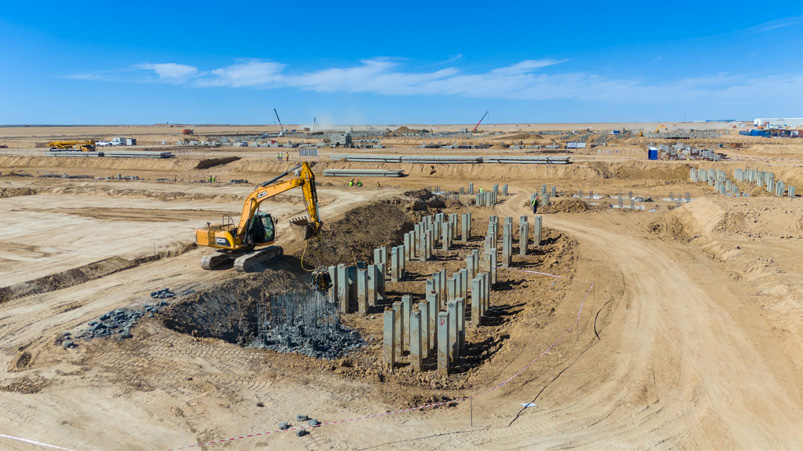
As part of its 2022-2031 Development Strategy, the Company is consistently expanding its oil and gas chemicals segment as one of the key drivers of value creation and enhanced business model sustainability.
In 2025, the implementation of oil and gas chemical projects covered the main product lines targeting domestic and international markets. Construction of the polypropylene production project (capacity - 500,000 tonnes per year) was completed and the commissioning certificate was signed. In 2025, 377,000 tonnes of products were produced, including 186,600 tonnes attributable to KMG (+51.4% compared to the previous year).
Under the Polyethylene project (capacity - 1.25 million tonnes per year), construction works have commenced and Engineering, Procurement and Construction (hereinafter - EPC) contracts have been signed; the project is being implemented with the participation of strategic partners SIBUR and Sinopec. Under the Carbamide project, a framework agreement was signed with China National Petroleum Corporation (hereinafter - CNPC), and the Feasibility Study has been completed.
The implementation of these projects forms the basis for the development of the oil and gas chemical clusters, the deepening of feedstock processing, and the expansion of the product portfolio, while supporting the phased diversification of the business.
Strategic Goal No. 4
Sustainable Development and Progressive Reduction of Carbon Intensity of Production
The Company continued to implement a comprehensive approach to sustainable development aimed at the gradually reducing of the carbon intensity of production processes and the development of low-carbon energy sources. Relevant initiatives are being carried out within the framework of the long-term climate and investment agenda, taking into account industry-specific factors and the regional context of company’s operations.
Key areas of focus during the reporting period included projects in renewable and hybrid power generation, as well as measures to manage greenhouse gas emissions, including methane. The implementation of these initiatives enables the Company to simultaneously address decarbonization objectives, improve the reliability of energy supply, and reduce operational risks.
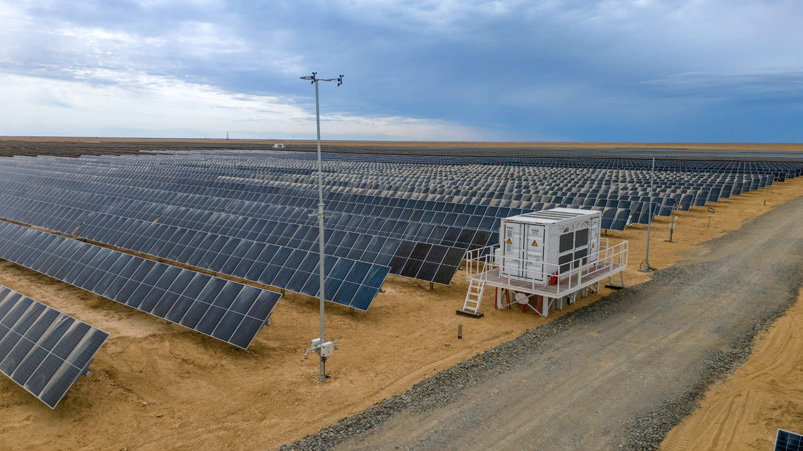
In the Mangystau Region, implementation continues on the hybrid power plant project in Zhanaozen with a total installed capacity of 247 MW, comprising a solar power plant (50 MW), a wind power plant (77 MW), and a gas-fired power plant (120 MW). In 2025, the installation of photovoltaic panels for the solar power plant was completed in full. In September 2025, comprehensive testing was completed and the 50 MW solar generation facility was commissioned. The project is being implemented in partnership with Eni during the period 2024-2026.
In the Zhambyl Region, the "Mirny" wind power plant project is underway, with an installed capacity of 1 GW and an energy storage system of 300 MW / 600 MWh. In December 2025, a Subscription Agreement was signed, providing for the acquisition by KMG Green Energy LLP of a 20% equity interest in Aktas Energy LLP (a joint venture with Total Energies Renewables SAS). The project partners are Total Energies Renewables SAS and "Qazaq Green Power" PLC, with an implementation timeframe of 2025-2028.
As part of its methane emissions management efforts in 2025, the Company conducted field measurements at the facilities of JV KazGerMunai LLP and Mangistaumunaigas JSC jointly with Carbon Limits.
In May 2025, reporting on methane emissions of subsidiaries and affiliates was submitted to UNEP, along with an action plan for implementing the requirements of the OGMP 2.0 initiative. In addition, satellite monitoring of methane emissions at subsidiary facilities, launched in 2023 with the support of OGCI and UNEP's IMEO, is ongoing.
The comprehensive implementation of these projects and initiatives provides the foundation for the consistent reduction of climate-related risks, improved energy efficiency, and enhanced long-term resilience of the Company's operations.
Key Performance Indicators
In 2025, key corporate initiatives of KMG were successfully implemented, enabling the achievement of the established performance targets.
Corporate Performance Targets Achievement in 2025
| Corporate Performance Indicators | Actual 2025 (Actual 2024), Indicator Description |
|---|---|
| Oil and gas condensate production volume | 26,211 thousand tonnes (2024 – 23,837 thousand tonnes) |
| Implementation of investment projects | 8 projects (2024 – 6 projects) |
| EBITDA margin excluding trading | 45% (2024 – 44%) |
| TSR (total shareholder return) | 40.65% (2024 – 28.55%) |
| Integrated industrial safety indicator | 75% (2024 – 125%) |
| Share of in-country value in procurement of goods, works and services of the KMG Group | In 2025, the share of in-country value in the procurement of goods, works and services of the KMG Group amounted to 70% for goods and 90% for works and services (2024 – 55% and 89%, respectively). |
| Approval of the Roadmap for projects involving artificial intelligence (at least 6 projects) |
The KPI reflects the approval of the Roadmap for projects involving artificial intelligence (the Roadmap must include at least 6 projects with AI components). The Roadmap was approved by the KMG Board of Directors on 4 December 2025. (Indicator introduced in 2025.) |
The performance indicator values are preliminary. Final approval of the actual 2025 indicator values by the KMG Board of Directors is expected in June 2026.
Performance Evaluation
To ensure the implementation of strategic objectives in the area of sustainable development at the executive level, key performance indicators (KPIs) for the Chairman of the Management Board (the Company's corporate KPIs) related to the implementation and development of the sustainable development system were approved for 2025:
- "Implementation of investment projects", including sustainability-related projects, such as the construction of a hybrid power plant with an installed capacity of 247 MW in partnership with Eni;
- "Integrated industrial safety indicator", aimed at reducing the level of occupational injuries, identifying unsafe conditions and hazardous factors, and ensuring systematic reporting on them across the KMG Group.
In addition, for the reporting year, functional sustainability KPIs were established at the level of the Deputy Chairmen of the Management Board and the heads of structural units. These KPIs cover the environmental, social, and governance aspects of the Company's activities, including:
- the implementation of investment projects, including sustainability related projects;
- reducing the number of production downtime days at KMG's subsidiaries and affiliates in the Mangystau Region caused by social risks, including strikes by employees of KMG subsidiaries and contractors;
- developing and improving the social and living infrastructure of KMG subsidiaries and affiliates, including the construction and renovation of socially significant facilities;
- achieving target indicators for the CDP rating and the ESG rating;
- approving and implementing environmental protection programs;
- reducing the non-work-related fatality rate (NWRF);
- implementing and completing Qorgau cards across subsidiaries and affiliates;
- conducting workshops on organizing and preparing for emergency response;
- conducting emergency response drills for major accidents and emergencies at hazardous production facilities;
- implementing measures to improve electricity planning and consumption efficiency across subsidiaries and affiliates;
- Implementation of the action plan within the framework of the Year of working professions in the KMG Group;
- Implementation of KMG's Human Resources Policy;
- Automation of HR processes at the KMG corporate center;
- Development and implementation of KMG's Corporate Well-being Program.
Development of the Sustainability Management System
The Company continued to refine its sustainability management system, focusing its efforts on the integration of ESG approaches into key business processes and management decision-making. During the reporting period, priority attention was given to decarbonization, the management of climate and water-related risks, the reduction of environmental impacts, the advancement of social responsibility, and the improvement of corporate governance practices.
Throughout the year, the Company implemented and updated programs and action plans in the areas of low-carbon development and land rehabilitation. Work continued the disclosure of climate and environmental information in accordance with international guidelines and standards, including IFRS S2 and CDP, as well as on improving the quality of non-financial reporting.
In the social domain, the Company further developed its approaches to human capital management, occupational health and industrial safety, engagement with local communities, and the protection of human rights. In the area of corporate governance, 2025 saw continued integration of ESG considerations into the leadership performance evaluation system, enhanced transparency of disclosures, and the further development of anti-corruption and compliance procedures.
The implementation of these initiatives is aimed at strengthening business resilience, mitigating ESG risks, and creating long-term value for stakeholders, while ensuring the Company's consistent progress in line with national and international sustainable development goals. Below is an overview of the key activities implemented during the reporting period, as well as the results achieved and the current progress of the Company in the field of sustainable development.
Key Initiatives in the Field of Sustainable Development and the Status of Their Implementation in 2025
| Key Area | Key Activities | Implementation Status |
|---|---|---|
| Environmental | ||
| Greenhouse Gas Emissions Management and Low-Carbon Development | Updating and implementing the low-carbon development action plan | The plan was approved by the decision of the KMG Management Board in March 2025 |
| Disclosure of climate information and climate-related risks (CDP Climate Change) | The information is disclosed in the Sustainable Development Report. The CDP questionnaire has been completed and submitted. A “B” rating was received. More details: |
|
| Water Resources Management | Development of the Water Resources Management Program | The Program has been developed |
| Calculation and disclosure of water balance and water-intensity indicators | The information is disclosed in the Sustainable Development Report and the CDP questionnaire | |
| Disclosure of information in the CDP Water Security questionnaire | The CDP questionnaire has been completed and submitted. A “C” rating was received. More details: |
|
| Pollution Emissions Management | Development of pollution emissions reduction targets | The program has been developed |
| Disclosure of flaring activities | The information is disclosed in the Sustainable Development Report. See details in the Environmental Responsibility section |
|
| Implementation of World Bank initiatives to end routine flaring of associated gas | Flaring volume has been reduced by 86.4% compared to 2017. The information is included in the Sustainable Development Report. See more in the section The Company’s Contribution to the Achievement of the UN Sustainable Development Goals |
|
| Biodiversity and Land Restoration | Development of the Biodiversity Program | The program has been developed |
| Development and approval of rules for the closure and restoration of disturbed lands | The rules were approved by the decision of the KMG Management Board in February 2025 | |
| Disclosure of information on land restoration | The information is disclosed in the Sustainable Development Report | |
| Development of Sustainable Products and Technologies | Pilot project on CO2 capture, storage, and utilization (CCUS) | Screening of emission sources completed, further work is underway |
| Development of a feasibility study for blue hydrogen production | A feasibility study for blue hydrogen production has been completed | |
| Feasibility study of the SAF (Sustainable Aviation Fuel) project | In September 2025, a Framework Agreement was signed with Lanzajet on transitioning to the Front-End Engineering Design stage (hereinafter — FEED), under which all technical and economic solutions for the plant construction will be developed | |
| Social | ||
| Interaction with Local Communities | Development of Local Communities Development and Engagement Program | The program is under development |
| Disclosure of information on local community engagement | The information is disclosed in the Sustainable Development Report | |
| Human Rights | Update of the Human Rights Policy | The Policy was approved by the decision of the KMG Board of Directors in June 2025 |
| Development of the Human Rights Program and human rights impact assessment | The Statement of Commitment on Human Rights and Gender Equality was signed in February 2025. An assessment of the Human Rights Policy and HRDD procedures was carried out. | |
| Human Capital Development | Update of the KMG Human Resources Policy | The Policy was updated and approved by the decision of the KMG Board of Directors in December 2024 |
| Disclosure of information on human capital | The information is disclosed in the Sustainable Development Report | |
| Implementation of the “Green Office” project | A number of initiatives on the rational use of resources have been introduced | |
| Occupational health and safety | Update of the OHS, Process Safety and Environmental Safety Roadmap | The Roadmap was approved by the decision of the KMG Management Board in February 2025 |
| Update of safety KPI reporting rules (contractor perimeter for LTIR/FAR) | The rules were updated and approved by the decision of the KMG Management Board in December 2024 | |
| Disclosure of safety performance indicators | The information is disclosed in the Sustainable Development Report | |
| Governance | ||
| Board of Directors | Disclosure of information on the composition and independence of the Board of Directors and its committees | The information is disclosed in the Annual Report and the Sustainable Development Report |
| Gradual increase of the share of women on the Board of Directors to 30% | The implementation of the initiative continues. The share of women on the Boards of Directors / Supervisory Boards within the KMG Group is 13.1% | |
| Transparency of remuneration | Disclosure of remuneration of Board members and senior management | The information is disclosed in the Annual Report |
| Updating and approving the Rules for evaluating the performance of senior managers, managerial staff, the Head of Internal Audit, the Corporate Secretary, the Head of the Compliance Service, and the Ombudsman, considering sustainable development KPIs | The rules have been updated | |
| Disclosure of corporate KPIs and their performance results (by weight) in KMG’s reporting | The information is reflected in the Annual Report | |
| Anti-Corruption Measures and Compliance | ISO 37001 certification | A certificate of conformity to the ST RK ISO 37001-2017 (ISO 37001-2016) standard has been obtained |
| Disclosure of tax information in accordance with the GRI standard and OECD Action 13 | The information is disclosed in the Sustainability Report and on the corporate website of KMG | |