INDUSTRIAL PROCESS SAFETY MANAGEMENT
During the reporting year, the KMG Group of Companies developed approaches to process safety management and improved the resilience of production processes. A key focus was on establishing a unified management and methodological framework to ensure coordination between the Corporate Center and its subsidiaries and affiliates, as well as the application of comparable approaches to assessing and mitigating process risks.
An important area of work is the refinement and further development of the target process safety management (PSM) model, including formalizing the principles of interaction between key functions and establishing unified standard approaches to implementing and maintaining processes at the production unit level. Plans call for the consistent strengthening management of change (MOC) system and the development of the process safety information (PSI) database as fundamental elements ensuring the manageability of production changes, the relevance of technical data, and the transparency of management decisions. Particular attention will be paid to the integration of these processes with existing management systems and internal procedures to ensure their practical application without the creation of duplicate management frameworks.
In 2026, it is expected that organizational mechanisms for implementing technological security initiatives will be developed, including:
- Improving project management.
- Coordination of roles and responsibilities of process participants.
- Building sustainable channels of interaction between the corporate level and production sites.
This approach will improve the predictability of task execution, the quality of control, and the timeliness of management decisions when implementing changes and activities that affect the level of technological risks.
Developing employee competencies will remain a separate priority. Throughout the year, we plan to expand training on key process safety principles and tools, including change management and approaches to hazard identification and analysis. Training will focus on developing a shared understanding of requirements, improving collaboration between involved departments, and reinforcing practical skills in applying the developed approaches in daily operations. In addition, work will continue developing specialized experts capable of providing methodological support for processes and ensuring the sustainability of implemented solutions.
In terms of information support, further development of approaches to managing technical and organizational information used to support process safety decision making is planned. Priority will be given to improving the structure, accessibility, and relevance of data required for accurate risk assessment and decision making in the context of changes, as well as to enhancing practices for using this information in operational processes. This area includes the development of key databases and registries that support the systematic recording and analysis of information:
- Process Risk Register – a database containing the assessment and classification of risks.
- Incident Register – a system for recording and analyzing incidents to prevent accidents in the future.
Overall, the planned activities are aimed at strengthening a unified approach to process safety, developing process manageability, increasing the maturity of key practices, and developing sustainable competencies. This will enable a consistent reduction in the likelihood of major process safety incidents and improve the reliability of the KMG Group’s production operations.
Digitalization of occupational health and safety
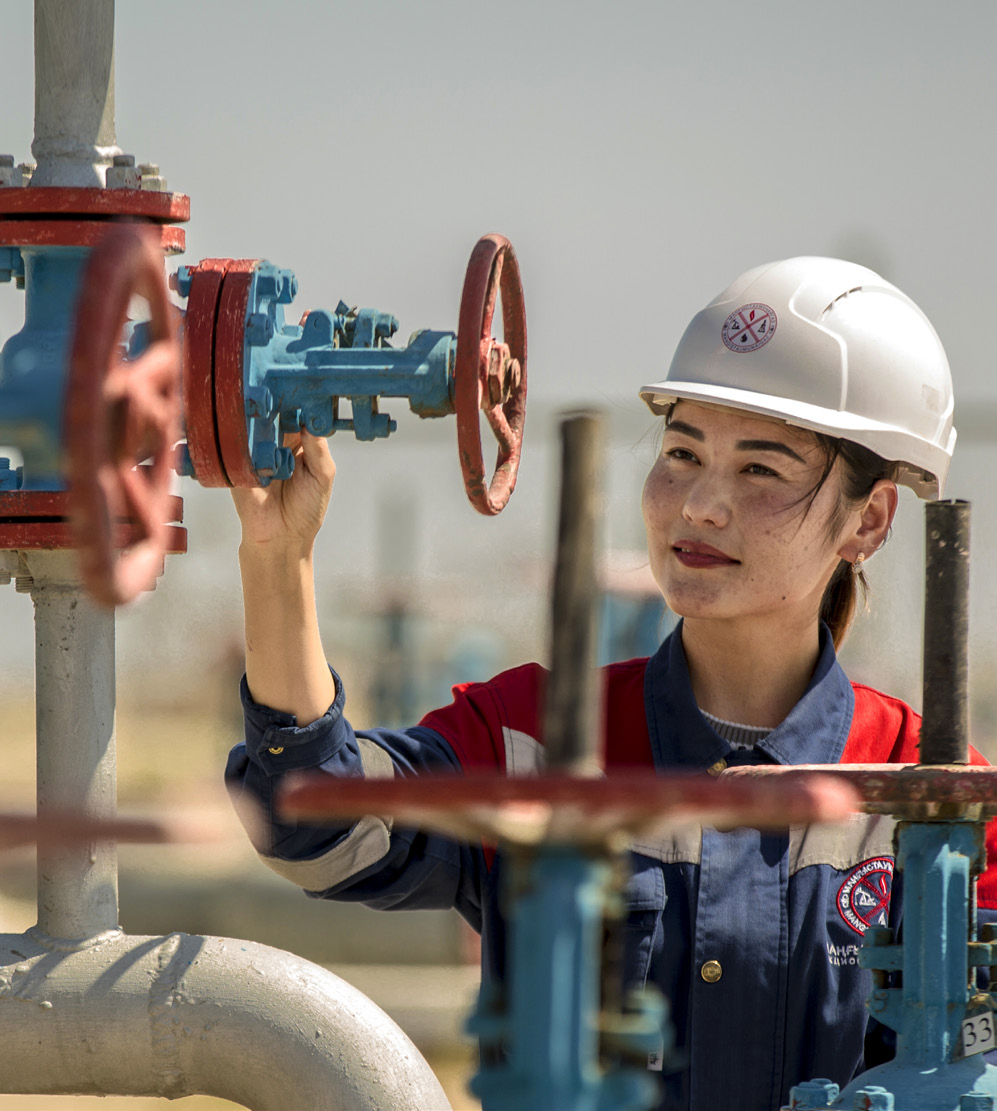
The Company continued work on the development and implementation of the automated intelligent process safety system “TUMAR,” aimed at preventing incidents and reducing negative impacts on employees during the performance of hazardous technological operations, including well workover activities.
In 2024, a pilot test of the “TUMAR” automated intelligent occupational safety system service was carried out on one capital well workover crew at the Zhetybai field operated by Oil Services Company LLP. In January 2025, a pilot launch of the system was conducted on 10 well workover and current repair crews at the Zhetybai and Kalamkas fields, during which all three modules operated normally.
The phased implementation of the TUMAR system continues across 60 well workover and current repair crews at the Zhetybai and Kalamkas fields at Oil Services Company. In 2026, the project is planned to be rolled out to the subsidiaries and affiliates of Ozenmunaigas JSC, Ozenmunaiservice LLP, Karazhanbasmunai JSC, and KazakhTurkMunai LLP.
In parallel, the implementation of an electronic permit to work system continues as part of the digitalization of industrial safety management processes. Since December 2023, the system has been in full industrial operation across all production structural units of Embamunaigas JSC. To replicate the solution, implementation activities were carried out in 2025 at Kazgermunai JV LLP.
Key performance indicators
GRI 403-9
As one of the largest industrial enterprises in the Republic of Kazakhstan, KMG places top priority on ensuring safe working conditions and protecting the health of its employees, as well as the population living in the areas where its production facilities are located. The Company consistently implements high standards of occupational health and industrial safety aimed at reducing operational risks and preventing accidents. According to the results of internal surveys, employees note that the Company provides a safe environment for carrying out their work activities.
In the reporting year, the number of people injured as a result of work related accidents remained unchanged compared to 2024 and amounted to 21 people. The number of road traffic accidents remained at the same level as the previous year, at 6. No fires were recorded in 2025.
During the reporting year, one fatal accident occurred at Ozenmunaigas JSC. During repairs to a water-oil emulsion heating furnace, a burner fell onto a maintenance mechanic, resulting in severe bodily injuries and the subsequent death of the employee. The deceased’s family received financial assistance in accordance with the terms of the collective bargaining agreement.
The investigation revealed that the incident occurred due to gross negligence on the part of the victim, violations of safety and health regulations, and deficiencies in the work organization. Following the investigation, corrective measures were implemented, including:
- conducting additional briefings and explanatory work,
- revising the technological regulations to incorporate safe work practices;
- mandatory familiarization of employees with the updated requirements.
TABLE 12. KEY INDICATORS IN THE FIELD OF OCCUPATIONAL HEALTH AND SAFETY 20
| 2023 | 2024 | 2025 | |
|---|---|---|---|
| Total number of work-related accidents, number of cases | 28 | 21 | 20A |
| Total number of victims of work-related accidents, number of people | 29 | 21 | 21A |
| Including fatalities, number of people | 2 | 1 | 1A |
| Road traffic accidents, number of cases | 19 | 6 | 6 |
| Fires, number of cases | 0 | 0 | 0 |
20. The classification and recording of occupational accidents are carried out in accordance with the requirements of the Labor Code of the Republic of Kazakhstan. In 2025, one fatal incident was recorded that was not related to production activities. Based on the results of the investigation, this incident was classified as non work related in accordance with Article 186 of the Labor Code of the Republic of Kazakhstan.
TABLE 13. KEY FACTORS OF INDUSTRIAL SAFETY
| 2023 | 2024 | 2025 | IOGP21 | |
|---|---|---|---|---|
| Lost Time Injury Rate (LTIR), per 1 million man hours | 0.30 | 0.22 | 0.21A | 0.21 |
| Fatal Accident Rate (FAR), per 100 million man hours | 2.11 | 1.03 | 1.01A | 0.57 |
| Motor Vehicle Collision Rate (MVCR), per 1 million kilometers traveled | 0.25 | 0.08 | 0.07 | 0.04 |
| Total man hours worked | 95,674,570 | 98,413,639 | 99,157,257 |
21. Available IOGP indicators for 2024 (https://www.iogp.org/).
Transport security
GRI 3-3, GRI 403-1, GRI 403-2, GRI 403-9
The Company places a high priority on transport safety as one of the key factors in reducing operational risks and ensuring occupational health and safety for its employees.
As part of the “Trip management” project, the transition of key transport management processes of oilfield service subsidiaries and affiliates (Oil Services Company LLP, Oil Transport Corporation LLP, Oil Construction Company LLP) to a digital format was completed. Industrial operation of the electronic request module for transport and special equipment was launched, and paper based workflows were fully eliminated. Automation was implemented for demand planning, preparation and execution of transport schedules, as well as monitoring the availability of vehicles and drivers.
The system is integrated with GPS platforms, enabling real time monitoring of vehicle movement and online notifications of road safety related incidents (speeding, harsh braking, and rapid acceleration). Basic analytical tools were introduced to provide real time control over request volumes, fulfillment rates, fleet utilization, and actual equipment usage. Functional prototypes of the “Waybills” and “Maintenance” modules were developed and approved, enabling end to end tracking of trips, mileage, and vehicle technical condition, with subsequent integration into accounting systems.
In 2026, the replication of the “Trip management” project is scheduled to be rolled out across the production assets of Karazhanbasmunay JSC, Mangistaumunaigaz JSC, and Ozenmunaigas JSC, with the implementation of core modules, including electronic transport requests, transport schedules, and an analytical dashboard.
In the reporting year, 6 road traffic accidents were recorded. The road accident frequency rate decreased by 0.004 cases per 1 million kilometers traveled compared to 2024.
To enhance road safety culture and raise awareness of seat belt use, two head-on collision simulator trainers (Convincer) were purchased in 2025 for Kazakhoil Aktobe LLP and Embamunaigas JSC. As of the reporting period, five Convincer simulators are in operation across the KMG Group (KazTransOil JSC, Ozenmunaigas JSC, Oil Transport Corporation LLP, Kazakhoil Aktobe LLP, and Embamunaigas JSC). Within the framework of the “Stop Traffic Accidents” campaign in 2025, practical simulator demonstrations were conducted with the participation of 22,394 people, including 20,073 employees of subsidiaries and 2,321 employees of contractor organizations.
An important element of improving transport safety is training under the Defensive Driving program in accordance with international RoSPA standards. In the reporting period, this training was completed by 5,002 people, including 1,592 employees of subsidiaries and affiliates and 3,410 employees of contractor organizations.
Fire safety
GRI 3-3, GRI 403-1, GRI 403-2, GRI 403-9
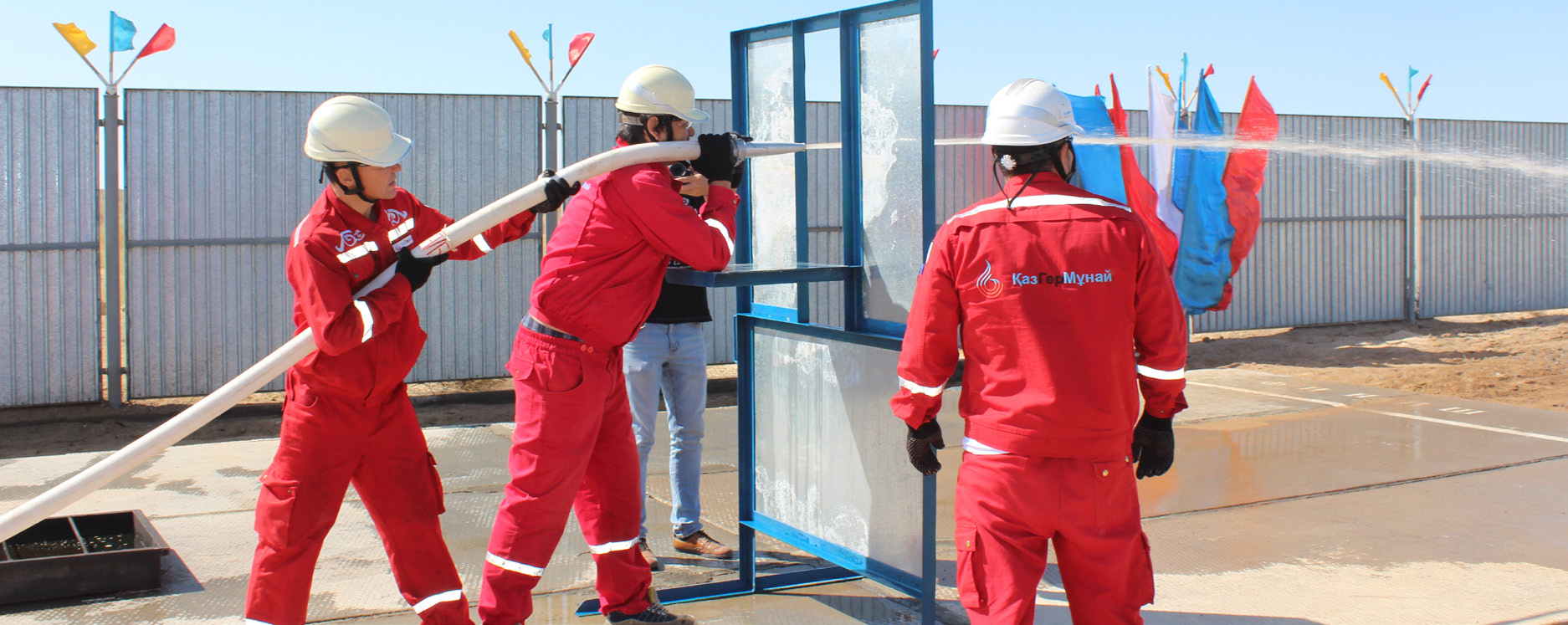
No fires were reported at KMG facilities during the reporting year. To improve fire safety at the Company’s subsidiaries and affiliates, a Roadmap for Improving Industrial, Occupational, and Environmental Safety in the KMG Group of Companies for 2025–2027 was developed and approved. As part of the roadmap’s implementation, a series of fire prevention measures were implemented during the reporting year, and scheduled fire and tactical exercises were organized and conducted at all subsidiaries and affiliates.
In accordance with the four-party Memorandum of Cooperation in the field of emergency prevention and response between the State Oil Company of the Azerbaijan Republic, KMG, Tatneft PJSC, and Uzbekneftegaz JSC, an emergency response exercise involving a fire and an injured person at a well operated by Embamunaigas JSC was conducted on 29 August 2025. The exercise involved forces and resources of the State Fire Service of the Atyrau Region Emergency Department of the Ministry of Emergency Situations of the Republic of Kazakhstan, as well as delegations from international partners.
In addition, an exercise was conducted to respond to a simulated fire at a vertical steel oil storage tank at JV CASPI BITUM LLP , with the participation of representatives of Samruk-Kazyna JSC and the Mangystau Region Emergency Department of the Ministry of Emergency Situations of the Republic of Kazakhstan.
During the year, two fire drills were conducted at KMG’s corporate center, involving personnel evacuation and practicing actions to extinguish a simulated fire in the building.
To provide methodological support and enhance the readiness of personnel at KMG subsidiaries, measures were implemented during the reporting year to strengthen fire protection during fire hazardous, heating, and holiday periods, along with awareness raising activities to reinforce compliance with fire safety requirements.